
18 nóvember 2026Crack and utility repairs in Grindavík nearing completion
Since August 2024, the Icelandic Road and Coastal Administration (Vegagerðin) has overseen extensive works in Grindavík on behalf of the Grindavík Committee, which coordinates recovery efforts following seismic and volcanic activity in the town. The works have been carried out in accordance with the committee’s action plans and have included repairs to fissure-affected areas, streets, utility networks, open spaces and other infrastructure throughout the town.
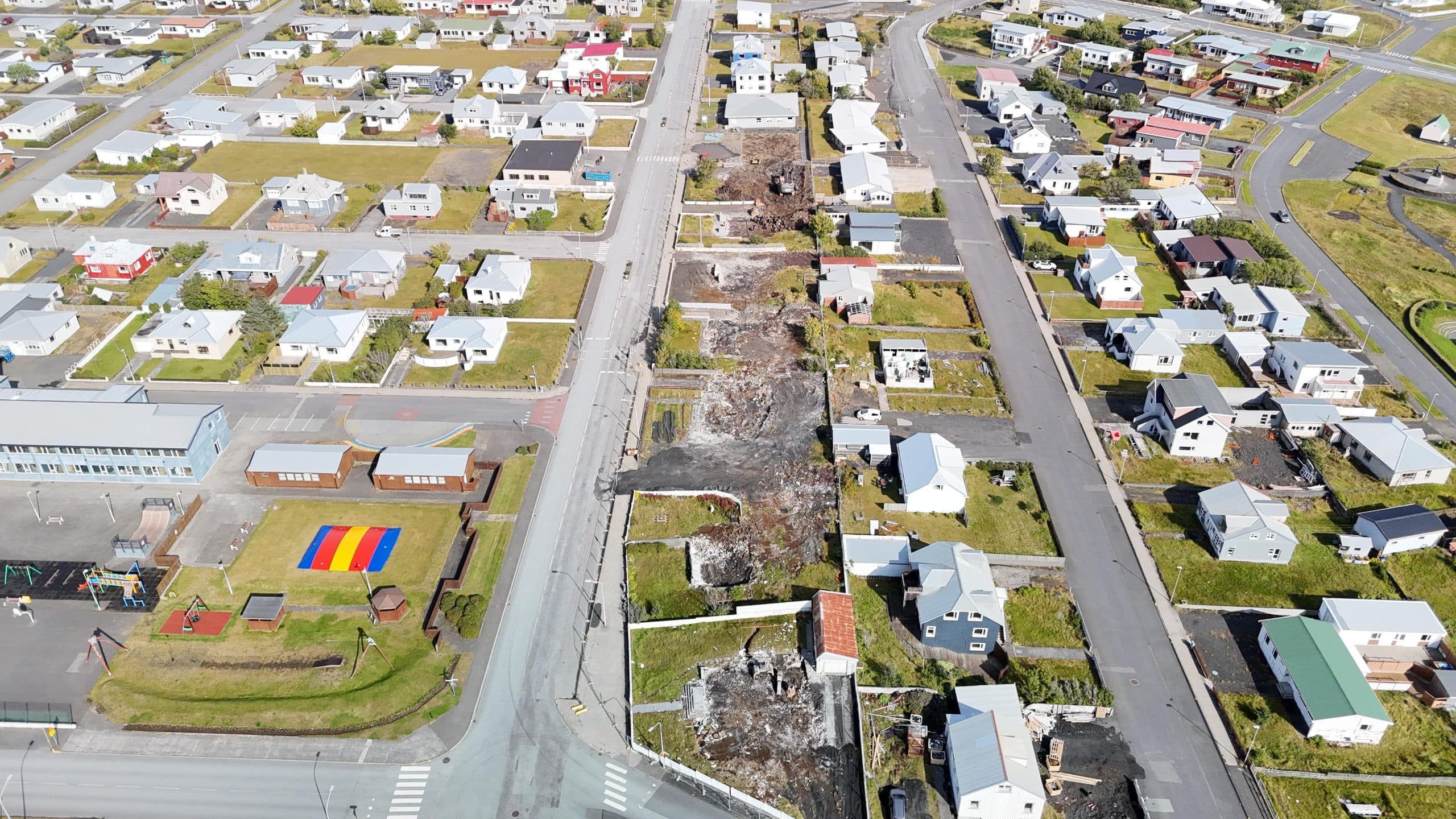
Rífa þurfti nokkrar byggingar við Víkurbraut.
This article was first published in Framkvæmdafréttir, issue 4, no. 741, 2026.
The seismic and volcanic activity that began in 2023 created unprecedented conditions in the town of Grindavík. Fissures, ground subsidence and underground voids developed in numerous locations, causing extensive damage to infrastructure and properties. Action plans were drawn up to address these conditions through repairs and infrastructure reconstruction.
To date, expenditure on works under Action Plans 1 and 2 totals approximately ISK 1 billion.
Action Plan 1
The first action plan was introduced in summer 2024. Its objectives were to improve safety within the town, ensure access along key transport routes and enable businesses and services to continue operating. The works included repairs to streets, utility networks and areas with open fissures, as well as the installation of safety fencing, coastal protection works, ground investigations and risk assessments.
The Icelandic Road and Coastal Administration (Vegagerðin) assumed the role of project client on behalf of the Grindavík Committee, working closely with a delivery team responsible for coordinating construction, safety and cost control.
The main priorities were to make key transport routes safe, fence off hazardous areas and undertake the first major fissure repairs. These measures enabled Grindavík to reopen to the public in October 2024, once the main routes had been repaired and hazardous areas secured.
Action Plan 2
Following the initial measures, the Grindavík Committee developed Action Plan 2, covering further repairs to areas with open fissures and within individual plots, additional ground investigations and continued infrastructure reconstruction. The total cost of works under Action Plan 2 is estimated at ISK 886 million, with a delivery period of up to 18 months.
In September 2025, the Grindavík Committee and Vegagerðin signed an agreement under which Vegagerðin took responsibility for implementing the plan, including tendering, contracting, supervision and project management.
A framework agreement was established with eleven contractors for fissure and utility repairs, with individual projects awarded through mini-competitions among those contractors. In total, 14 mini-competitions have been launched or prepared.
Much of the work already completed
Fissure repairs are now well advanced, and numerous projects have been completed. These include works at Hópsskóli school, the sports hall, Efrahóp, Bröttuhlíð, Ufsasund, Austurvegur and Mánagata, Staðarsund and Vörðusund, as well as Víkurtún. Safety fencing has been removed from several of these areas following completion of the repairs.
Numerous projects remain under way across the town, including at the sports field, Spóahlíð, Norðurhóp, Austurhóp, Víkurbraut and Víkurhóp. Progress varies, and in some locations the next steps depend on the demolition of structures or further investigation of underground voids.
The repairs have also demonstrated how difficult it can be to anticipate conditions below ground. At Víkurhóp, for example, a large horizontal void extending westwards was discovered, along with substantial openings. Further excavation and investigation are therefore needed to determine the extent of the voids before repairs can be completed.
Excavating down to solid lava bedrock
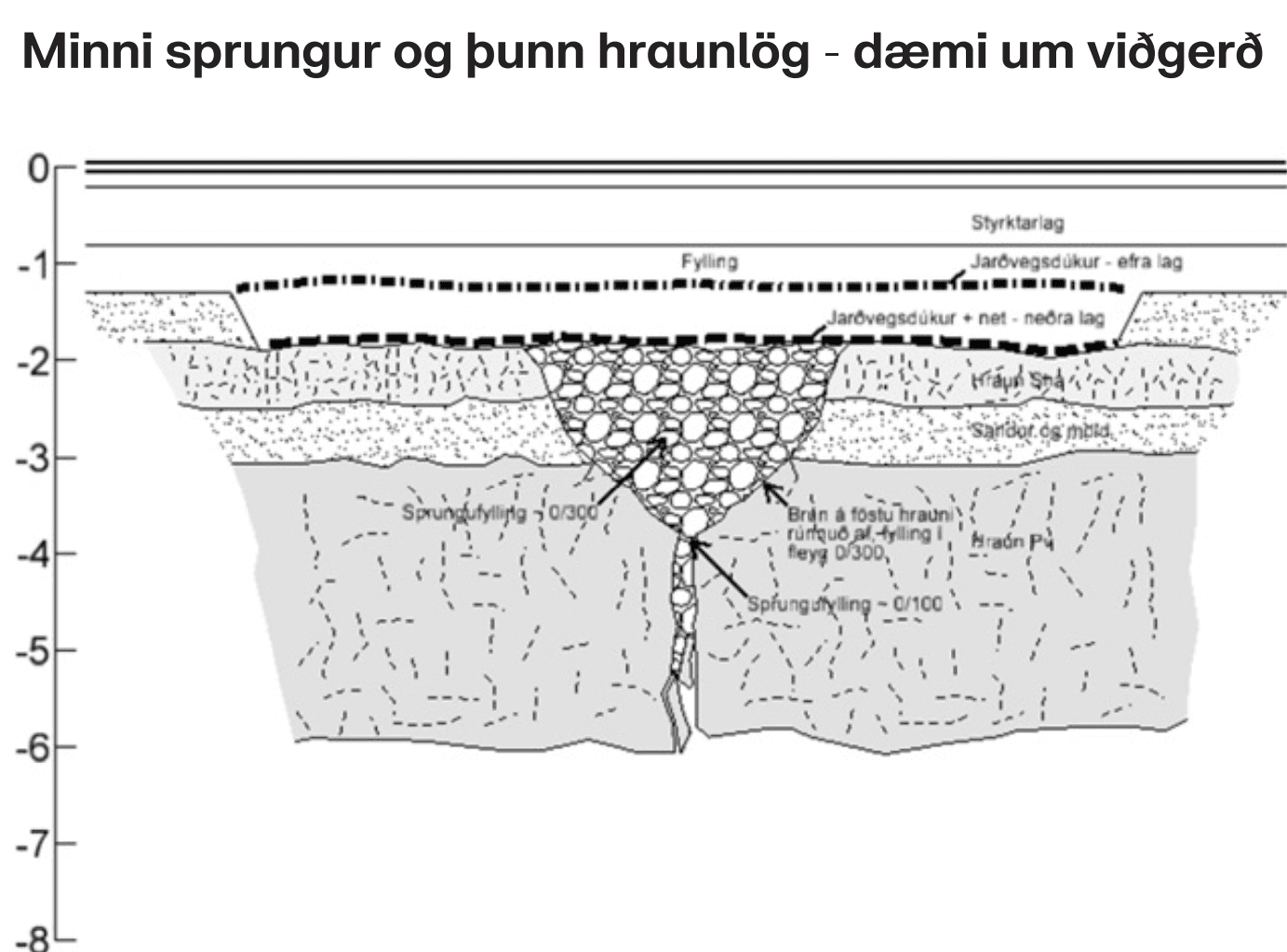
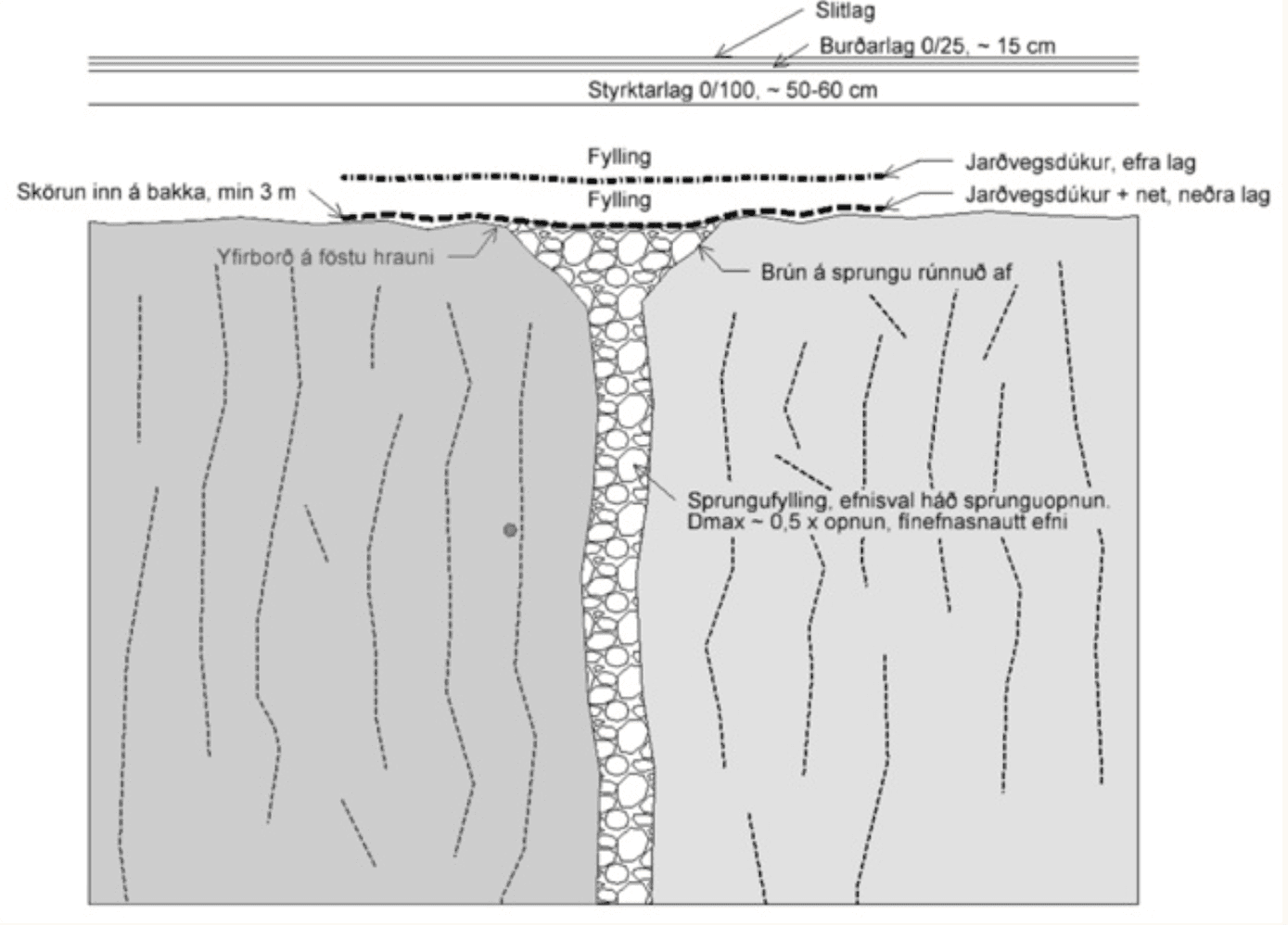
The repairs involve considerably more than filling visible cracks at the surface. Loose soil, lava rubble and older fill material are removed, and excavation continues down to solid lava bedrock. The fissure is then cleaned out and filled with coarse material containing minimal fines.
A geotextile and, where required, a reinforcing geogrid are laid over the fill before conventional road or surface construction begins. The aim is to provide sufficient flexibility for the repair to accommodate some further ground movement without the surface immediately cracking again.
Further work ahead
Although much of the planned fissure repair work is now complete, further projects remain. The largest outstanding areas are Vesturhóp and Hópsnes, alongside smaller projects on private plots. In some locations, structures must first be demolished to provide access to the fissures.
Ground investigations will also continue. A memorandum on Þorbjörn has been prepared, and the next areas scheduled for investigation are Bótarsvæðið and the area between the uppermost residential neighbourhoods and the protective barriers. A further LiDAR scan of Grindavík is also planned.
The works carried out over the past two years have involved more than repairing known fissures. They have also generated extensive knowledge of the fissure systems running through Grindavík, underground voids and ways of responding to conditions with few precedents in Icelandic towns. This knowledge will inform both the remaining projects and the continued reconstruction of infrastructure in Grindavík.
The Grindavík Committee concluded its work at the beginning of the year. Its projects are now overseen by the Prime Minister’s Office.*
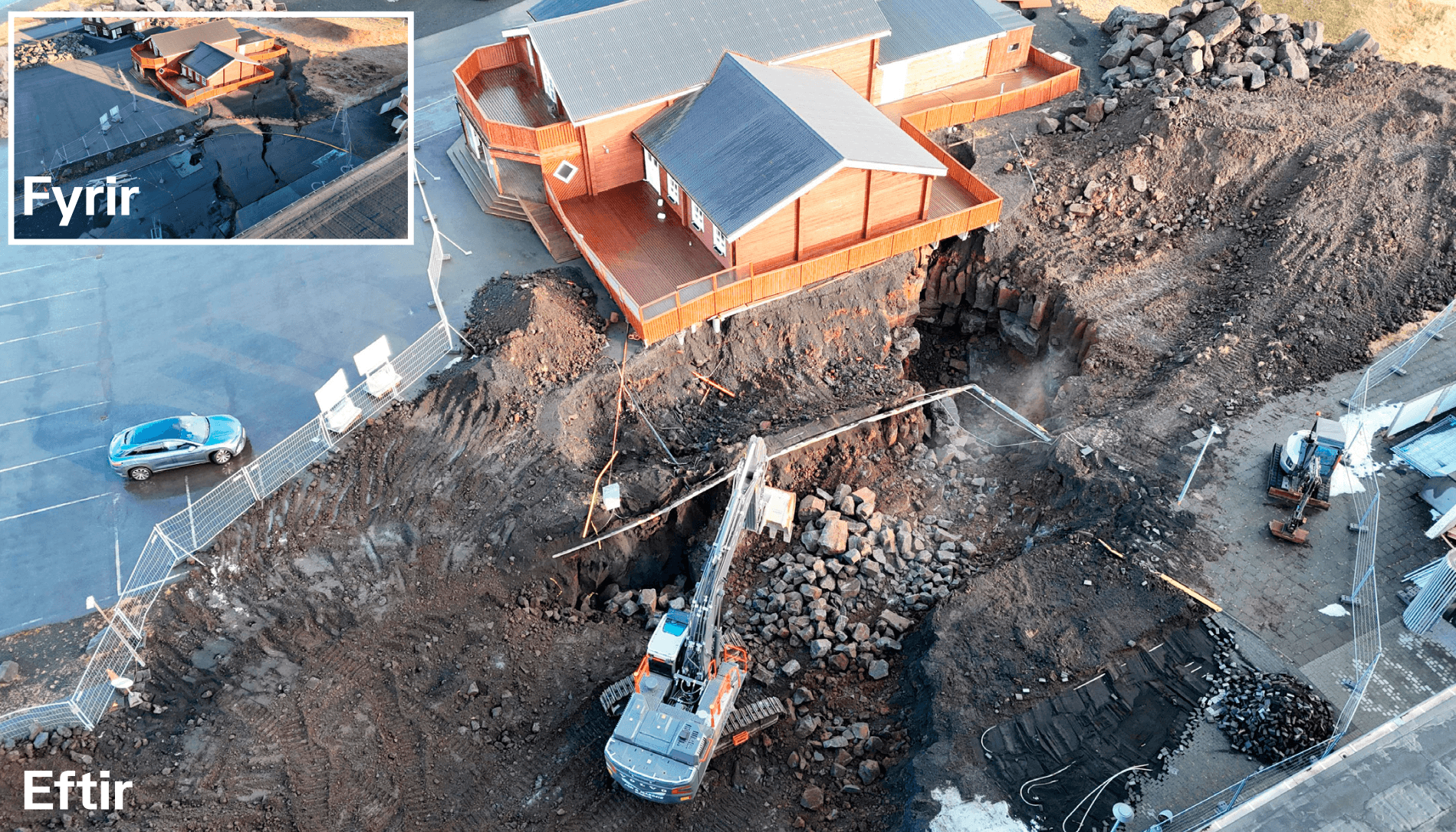
Miklar sprungur mynduðust við Salthúsið.
Completed projects
- Víkurtún
- Hópsskóli school
- Sports hall and Sólarvé
- Efrahóp
- Brattahlíð
- Ufsasund
- Austurvegur and Mánagata
- Staðarsund and Vörðusund
Projects under way in September 2026
- Fálkahlíð and Kríuhlíð
- Sports field: Work is under way to overfill the eastern fissure and excavate the western one. Further investigations will also be carried out to locate a void in the embankment known as the “Pac-Man hole”. At Salthúsið, work is under way to close off the gable end.
- Spóahlíð: The fissure has been excavated along its full length. A small void was discovered in the lower part of the site and has been addressed. Fill is being placed in preparation for the geotextile, which has already been laid over part of the area.
- Norðurhóp: The entire work area has been excavated. Relocating an electrical cabinet is facilitating further work, and the project is nearing completion.
- Austurhóp: Approximately half of the work is complete.
- Víkurbraut: Work has been carried out on three plots extending from the trade union building. The anticipated voids were not found, so excavation will proceed outwards from a known void.
- Víkurhóp: Excavation has extended beyond Víkurhóp 20. A large horizontal void extending westwards and several large openings were discovered. Further excavation to the west is needed to investigate and repair the voids.
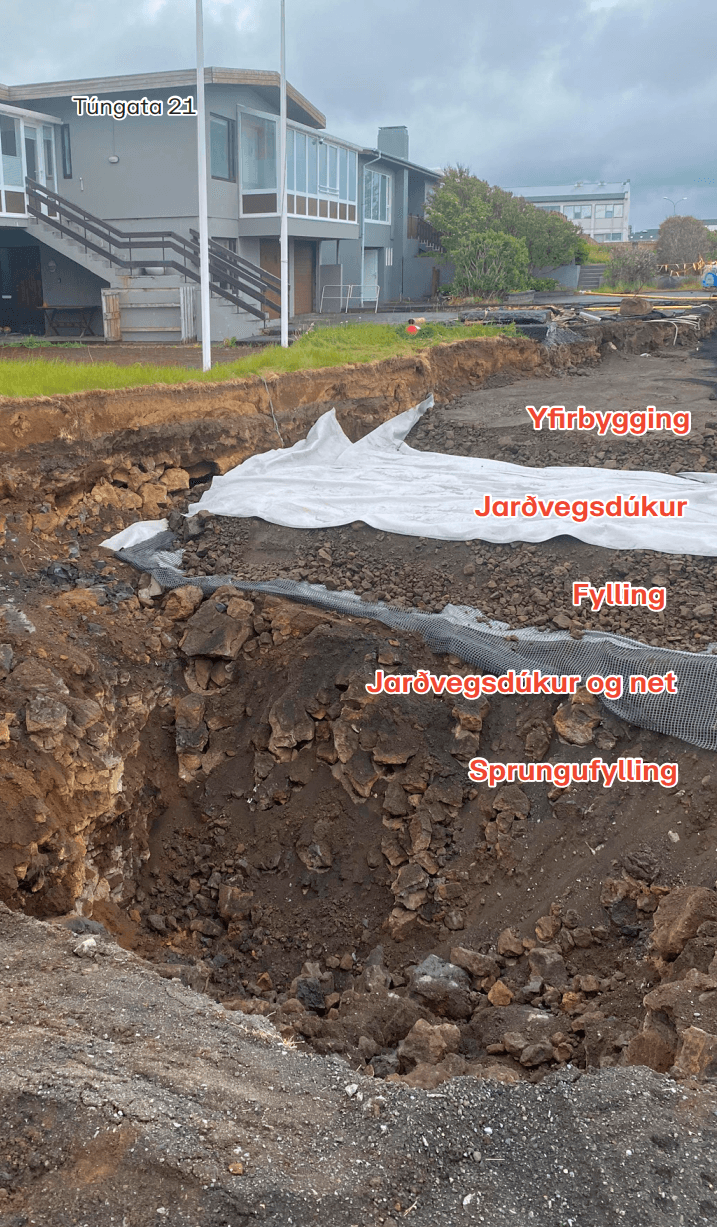
Myndin sýnir uppbyggingu viðgerðar.
Upcoming work
At Garður and Hóp 1, demolition must be completed before fissure repairs can begin. A solution is also being sought for two houses on Víkurbraut so that demolition can be completed and repairs can begin. The Municipality of Grindavík has also begun preparations to demolish houses at Vesturhóp 9, 10 and 30.
- Repairs at Vesturhóp and Hópsnes.
- Defining the scope of repairs to a fissure above the residential area, based on ground investigations.
- Possible minor repairs to Hópssprunga alongside path construction.
- Basic cordoning off of areas at Stamphólsgjá and Strandhóll.
- Smaller projects on private plots as permission is obtained for demolition or fissure repairs.
- Further ground investigations in Bótarsvæðið and between the uppermost residential areas and the protective barriers.
- A repeat LiDAR survey of Grindavík to map the ground surface and changes to it.
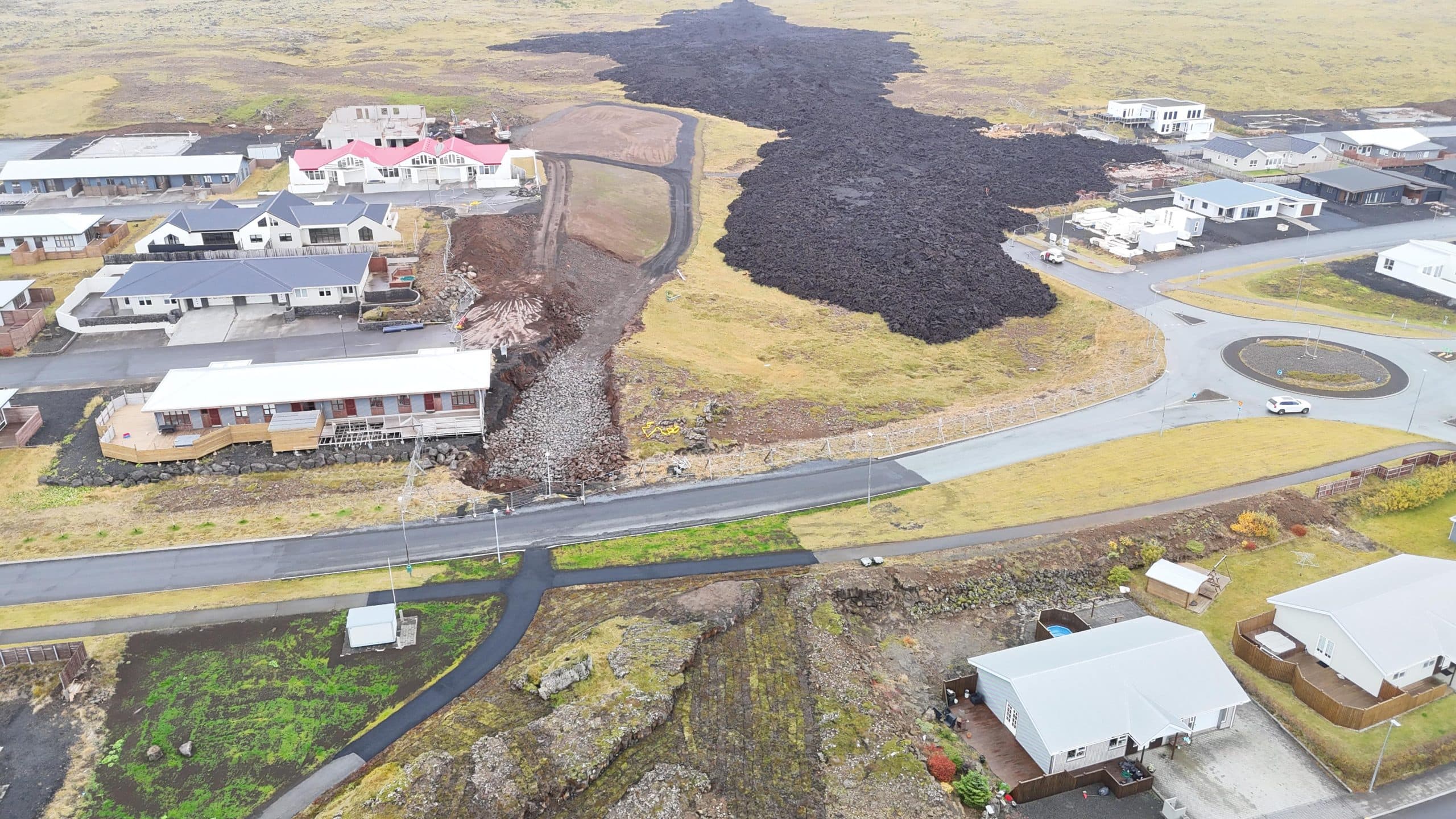
Framkvæmdir við Norðurhóp. Hér sést hversu nærri hraunið rann.
Repairing smaller fissures
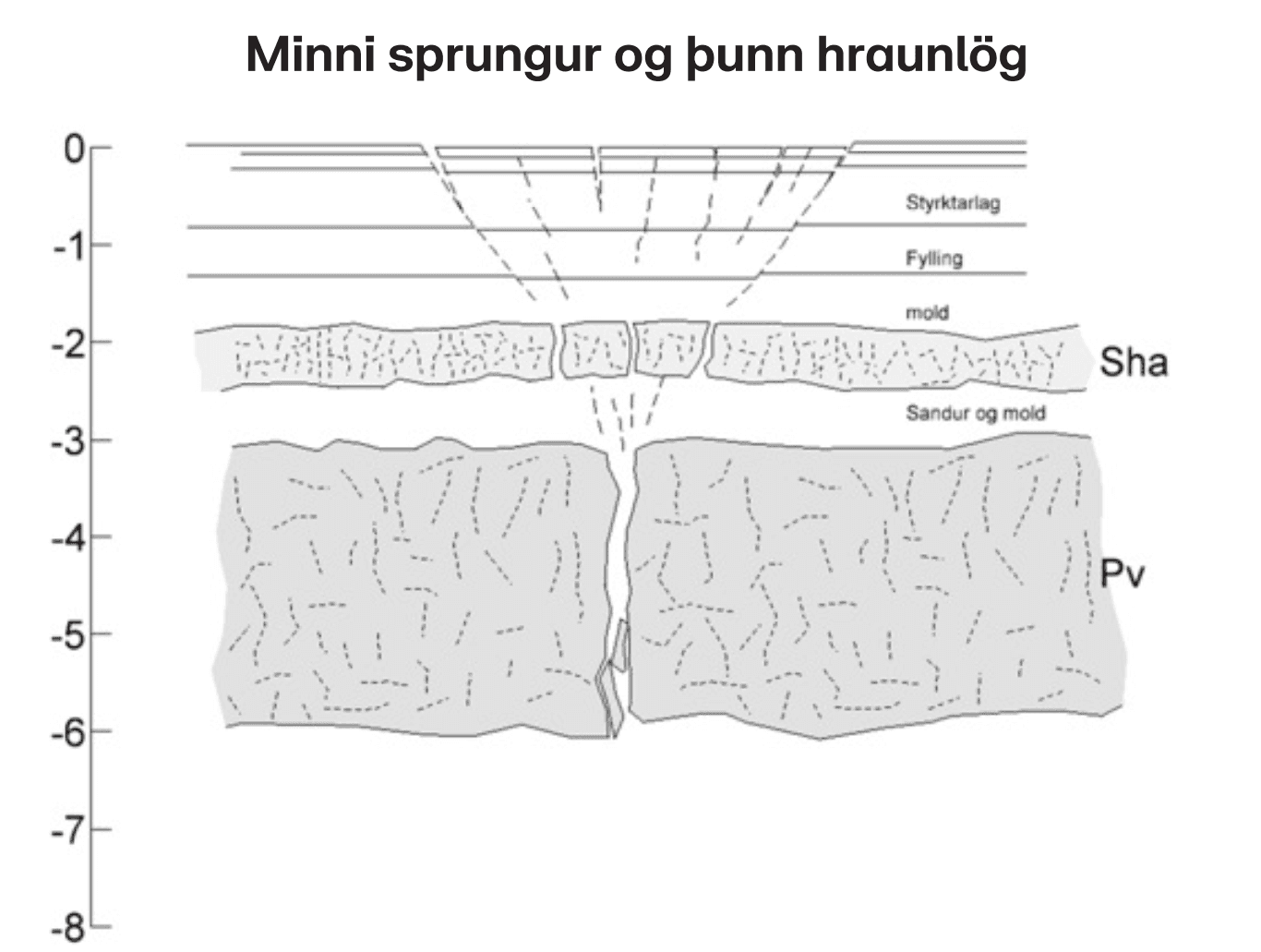
Fissures in eastern Grindavík are generally younger, and some may have formed during recent events. The lava flows in this area are thinner and have smaller columns, making them more likely to break into smaller blocks that bridge or close fissures more effectively. The illustration below shows a fissure of this type and an example of the repair method used.
Repairing larger fissures
A wedge-shaped profile at the top of the fissure promotes arching within the fill. The fill must be free of fines so that the stones remain firmly interlocked. Geotechnical reinforcement, including geotextiles and geogrids, is used to hold the overlying material in place. If further ground movement occurs, the fill is prevented from collapsing into the fissure, maintaining the arching effect. This makes the repair flexible and resilient, allowing the surface to deform without breaking.
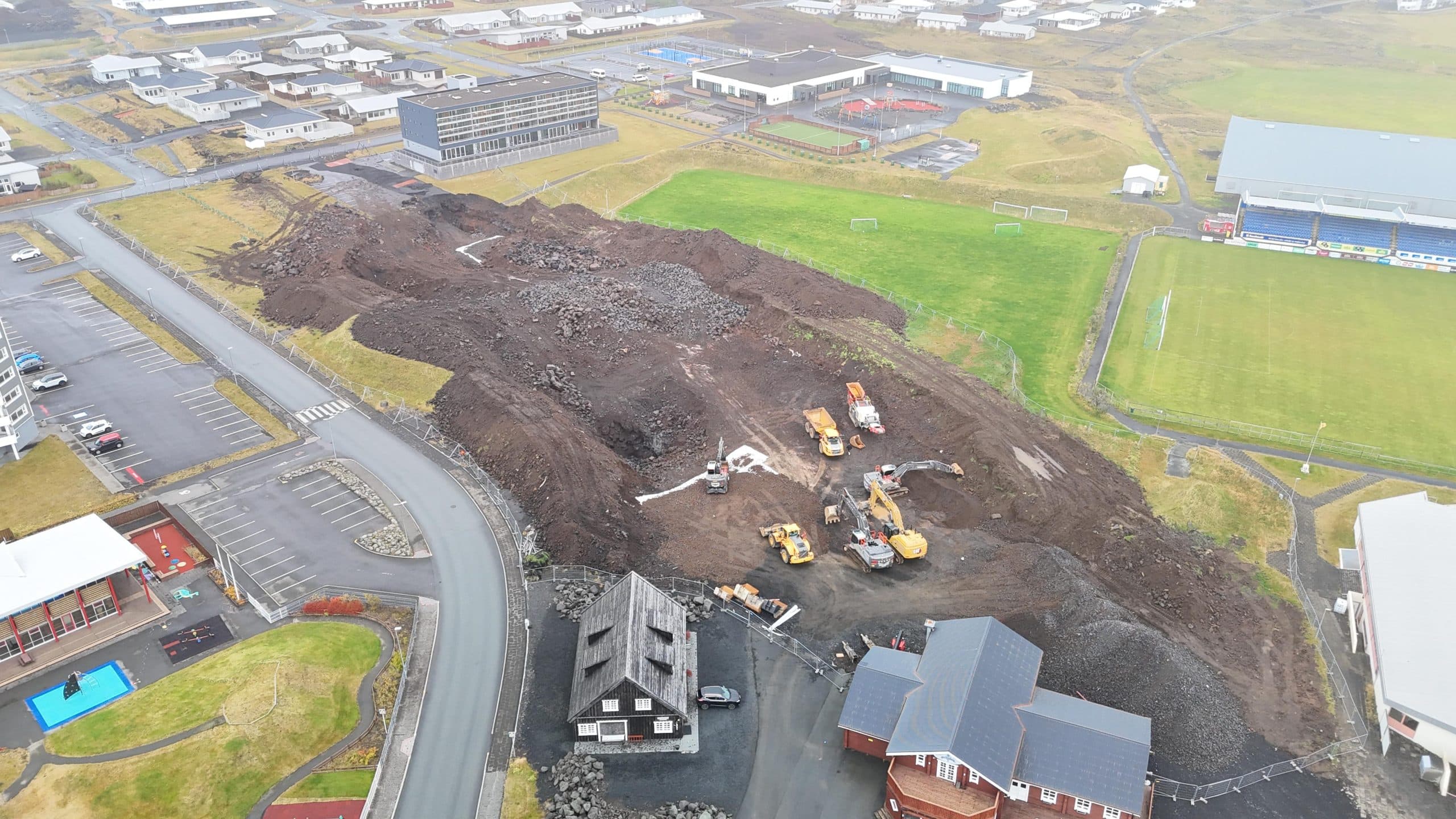
Viðamiklar framkvæmdir við íþróttavöllinn í bænum.
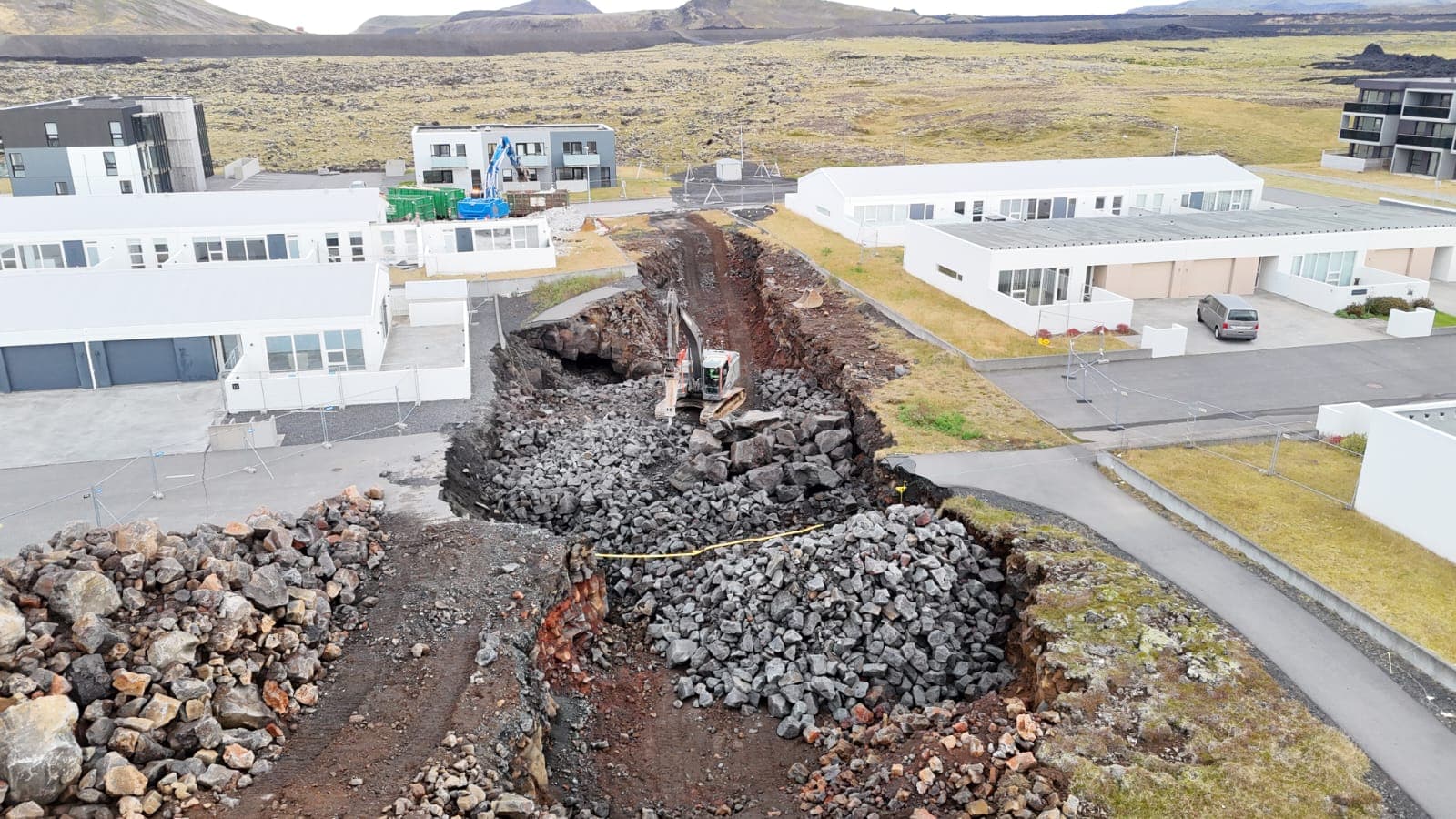
Við Víkurhóp fannst stórt lárétt rými til vesturs og nokkrar stórar opnanir.